
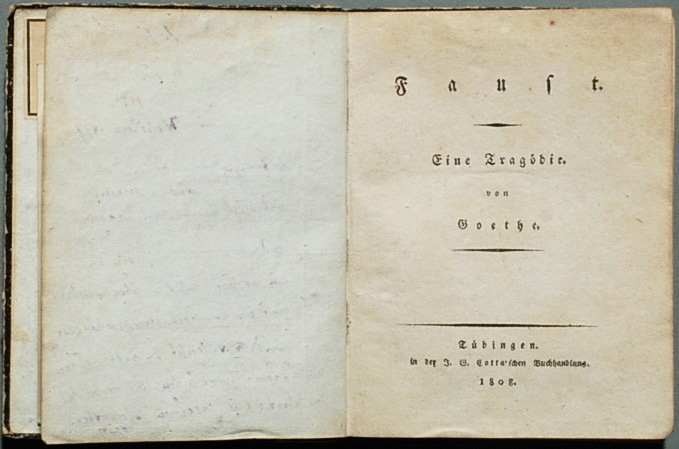
Faust by Johann Wolfgang von Goethe
Theodoros Kafantaris
Published on July 07, 2026
1. Introduction
What would you trade for unlimited knowledge, power, and pleasure? Your soul? Your humanity? Goethe's Faust—written over six decades and published in two parts (1808, 1832)—transforms the medieval legend of a scholar who sells his soul to the devil into the defining masterpiece of German literature. It took Goethe his entire lifetime to complete; fittingly, the work itself is about a lifetime of striving, failing, and striving again.
Heinrich Faust, a brilliant but deeply dissatisfied scholar, has mastered every academic discipline—philosophy, law, medicine, theology—and found them all empty. In his despair, he makes a wager with Mephistopheles: if the devil can provide a moment so perfect that Faust wishes it to last forever, then Faust's soul is forfeit. What follows is a cosmic journey through love, tragedy, political power, classical mythology, and ultimately, an unexpected redemption.
2. About the Author
Johann Wolfgang von Goethe (1749–1832) was a German poet, playwright, novelist, scientist, statesman, and one of the most influential figures in Western literature. A central figure of the Sturm und Drang and Weimar Classicism movements, his works span drama, poetry, and prose. Faust, his magnum opus, occupied him for over sixty years and reflects his evolving philosophical and artistic vision. Goethe's other notable works include The Sorrows of Young Werther and Wilhelm Meister's Apprenticeship. His contributions to biology, color theory, and geology also mark him as a true Renaissance man.
3. Story Overview
Faust is divided into two parts, each distinct in tone and scope. Part One, often performed as a standalone play, is a tightly woven domestic tragedy. It opens with Faust in his study, lamenting his fruitless pursuit of knowledge. He turns to magic, conjures the Earth Spirit, but is rebuffed. In despair, he attempts suicide, only to be stopped by Easter bells. Soon after, Mephistopheles appears, and they strike a wager: Mephistopheles will serve Faust on Earth, but if Faust ever experiences a moment so sublime that he cries, "Stay, you are so beautiful!" his soul will belong to the devil.
Mephistopheles first leads Faust to a witch's kitchen, where a potion rejuvenates him. Faust then encounters Margarete (Gretchen), a young, devout woman. He seduces her with Mephistopheles' help, but the affair leads to tragedy: Gretchen accidentally kills her mother with a sleeping potion, her brother Valentine is slain by Faust, and she drowns her illegitimate child. Imprisoned and condemned to death, she refuses Faust's rescue, choosing instead to trust in God's mercy. Her soul is saved, while Faust is whisked away by Mephistopheles, burdened by guilt.
Part Two expands into an allegorical, episodic journey. Faust and Mephistopheles arrive at the court of a bankrupt emperor, where Faust uses paper money to solve the financial crisis. To entertain the court, Faust conjures Helen of Troy, but the vision overwhelms him. He then descends to the "Mothers"—primordial goddesses—to retrieve Helen's shade. Faust and Helen unite, symbolizing the union of Romantic and Classical ideals, and produce a son, Euphorion, who dies in a flight for freedom. Helen departs, leaving Faust with her garments.
In the final acts, Faust returns to the mortal world, now an old man. He undertakes a massive land reclamation project, but his ambition leads to the deaths of an elderly couple, Philemon and Baucis. Blinded by Care, Faust nevertheless envisions a free people living on reclaimed land. In his final moment, he utters the fateful words, "Stay, you are so beautiful!" expecting damnation. However, angels intervene, declaring that "whoever strives with all his might, him we can redeem." Faust's soul is saved, and Gretchen, now a penitent, intercedes for him in heaven.
4. Key Takeaways
- Striving defines us: It is not success but the effort itself that gives life meaning. Faust's relentless pursuit, despite his errors, leads to redemption.
- Knowledge without experience is empty: Faust's academic learning leaves him hollow; he must engage with life, love, and suffering to find fulfillment.
- Redemption is always possible: Goethe's universe is ultimately merciful to those who keep trying, even after grave sins.
- The journey matters more than the destination: Faust's wager is won not through a perfect moment but through a life of perpetual becoming.
5. Why This Book Is a Must Read
Faust is not merely a play; it is a philosophical epic that grapples with the deepest questions of human existence. Its exploration of ambition, sin, and redemption resonates across centuries. The character of Faust embodies the modern human condition—restless, flawed, yet striving for transcendence. Goethe's poetic language, rich symbolism, and fusion of tragedy and comedy create a work of unparalleled depth. Whether you are drawn to its psychological insights, its mythological sweep, or its moral complexity, Faust offers a transformative reading experience that challenges and inspires. It is a cornerstone of Western literature, essential for anyone seeking to understand the human spirit.


