
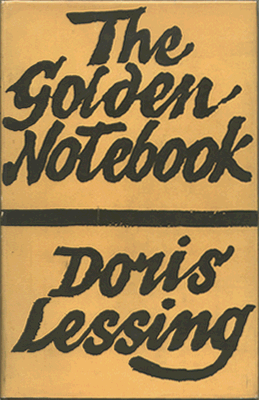
The Golden Notebook by Doris Lessing
Theodoros Kafantaris
Published on July 07, 2026
1. Introduction
Anna Wulf is a writer who cannot write, a communist who has lost faith, a mother afraid of failing. To hold herself together, she keeps four notebooks—black for writing, red for politics, yellow for fiction, blue for daily life. The golden notebook represents integration. Doris Lessing's The Golden Notebook (1962) expanded what fiction could address, breaking new ground in its exploration of women's inner lives and the fragmentation of modern existence. The novel is a landmark of feminist literature and a daring experiment in narrative form.
2. About the Author
Doris Lessing (1919–2013) was a British-Zimbabwean novelist, poet, and playwright, awarded the Nobel Prize in Literature in 2007. Born in Persia (now Iran) and raised in Southern Rhodesia (now Zimbabwe), she moved to London in 1949. Her work spans a wide range of genres, from realism to science fiction, but she is best known for her penetrating explorations of social and political issues, especially women's roles. The Golden Notebook is considered her masterpiece, a novel that shattered conventions and influenced generations of writers.
3. Story Overview
The Golden Notebook is a complex, multi-layered novel that defies easy summary. At its core is Anna Wulf, a novelist in her thirties living in London in the 1950s. Anna is blocked as a writer, unable to produce a second novel after her successful debut, Frontiers of War. To cope with her fractured sense of self, she keeps four separate notebooks, each dedicated to a different aspect of her life: the black notebook covers her experiences as a writer and her time in Africa; the red notebook documents her involvement with the Communist Party; the yellow notebook contains a fictionalized version of her own love life, centered on a character named Ella; and the blue notebook is a diary of her daily life, including her relationships, her daughter, and her psychoanalysis.
The novel is structured as a series of excerpts from these notebooks, interspersed with sections titled “Free Women,” which are a conventional narrative about Anna and her friend Molly. The “Free Women” sections are themselves a kind of fiction, as they are actually part of Anna's yellow notebook. This metafictional layering challenges the reader to question the nature of truth, memory, and storytelling. As Anna struggles to integrate the fragmented pieces of her life, she eventually begins a new notebook, the golden one, which attempts to synthesize all the others. The novel's climax involves a breakdown and a tentative recovery, suggesting that wholeness is an ongoing process rather than a final achievement.
Major themes include the politics of personal relationships, the failure of communism, the limitations of psychoanalysis, and the search for authenticity in a world of competing ideologies. Key characters include Anna's lover Michael (a married man who leaves her), her friend Molly (a fellow “free woman”), and Saul Green (an American writer who mirrors Anna's own creative block). Notable scenes include Anna's vivid memories of Africa, her painful affair with Michael, and the chaotic, transformative encounter with Saul. The novel's literary significance lies in its innovative structure, its frank depiction of female sexuality and mental illness, and its refusal to offer easy resolutions.
4. Key Takeaways
- Wholeness is a fiction: The novel suggests that a unified self is an illusion; we are all composed of multiple, often conflicting selves. Integration is not about erasing division but learning to live with it.
- The personal is political: Lessing argues that private struggles—love, sex, motherhood, creativity—are inseparable from public issues like communism, feminism, and war. True liberation requires addressing both.
- Women's liberation is unfinished: Despite the label “free women,” Anna and her friends are still constrained by societal expectations, internalized misogyny, and economic dependence. The novel remains a powerful critique of patriarchal structures.
5. Why This Book Is a Must Read
The Golden Notebook is essential for anyone interested in the evolution of the novel as a form. Its experimental structure—mixing diaries, stories, and a conventional frame—pushed the boundaries of what fiction could do. It is also a profound meditation on the challenges of being a woman, an artist, and a political being in the mid-20th century. The novel's insights into fragmentation, creativity, and the search for meaning remain startlingly relevant. For readers who appreciate ambitious, intellectually stimulating literature, The Golden Notebook is a rewarding and unforgettable experience.


