
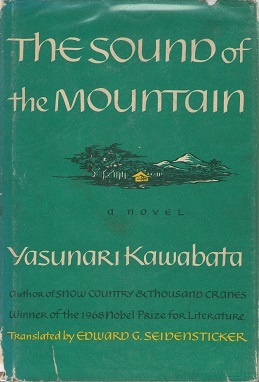
The Sound of the Mountain by Yasunari Kawabata
Theodoros Kafantaris
Published on July 08, 2026
1. Introduction
Shingo Ogata, an aging Tokyo businessman, hears a sound at night—a distant rumbling he calls "the sound of the mountain." It may be a premonition of death or simply the noise of his declining faculties. Yasunari Kawabata's The Sound of the Mountain (1954) is a novel of extraordinary subtlety: nothing dramatic happens, yet everything of importance occurs.
Shingo watches his children's marriages fail, dreams of a woman he once loved, and finds unexpected comfort in his relationship with his daughter-in-law Kikuko. Kawabata, who won the Nobel Prize in 1968, captures the texture of Japanese domestic life—the changing seasons, the tea ceremonies, the unspoken tensions—with a delicacy that makes the ordinary luminous.
2. About the Author
Yasunari Kawabata (1899–1972) was a Japanese novelist and short story writer who became the first Japanese author to receive the Nobel Prize in Literature in 1968. Orphaned at a young age, he grew up immersed in traditional Japanese aesthetics, which deeply influenced his writing. His works, including Snow Country, Thousand Cranes, and The Old Capital, are known for their lyrical prose, psychological depth, and exploration of loneliness and beauty. Kawabata's style blends modernist techniques with classical Japanese sensibilities, often focusing on fleeting moments and the subtle emotions of everyday life. He served as president of the Japanese PEN Club and was a key figure in introducing Japanese literature to the West. He died by suicide in 1972, leaving behind a legacy of profound literary artistry.
3. Story Overview
The Sound of the Mountain follows Shingo Ogata, a sixty-three-year-old businessman living in Kamakura with his wife Yasuko. The novel spans roughly a year, structured through a series of vignettes that capture the rhythms of Shingo's domestic life and inner reflections. The story opens with Shingo hearing a mysterious sound from the mountain near his home—a recurring motif that symbolizes his awareness of mortality and the passage of time. This sound, which others do not hear, becomes a touchstone for his growing preoccupation with death and regret.
Shingo's family is in turmoil. His son Shuichi is having an affair with a war widow, causing deep pain to his gentle wife Kikuko, who lives with the Ogatas. Shingo's daughter Fusako has returned home with her two daughters after her husband's infidelity, adding strain to the household. Shingo feels a profound sense of failure as a father, haunted by memories of his own past—particularly a lost love, the sister of his wife, who died young. His dreams of this woman blur the lines between past and present, revealing his unfulfilled desires and the weight of choices made.
Central to the novel is Shingo's relationship with Kikuko. He finds in her a quiet solace and a connection that transcends family roles. He observes her beauty, her suffering, and her resilience, often feeling more empathy for her than for his own children. Their interactions are marked by unspoken understanding and subtle gestures—a shared glance, a gentle word—that convey deep emotion. Kikuko, in turn, confides in Shingo, revealing her loneliness and her decision to have an abortion after Shuichi's affair, a choice that Shingo supports but cannot openly endorse.
The narrative is rich with symbolism drawn from nature and Japanese culture. The changing seasons—cherry blossoms in spring, cicadas in summer, autumn leaves, winter snow—mirror Shingo's emotional states and the cycle of life. Kawabata weaves in elements of traditional art, such as tea ceremony and Noh drama, to underscore themes of impermanence and beauty. The novel's climax comes when Shingo, after a series of dreams and reflections, finally confronts the sound of the mountain not as a threat but as a natural part of existence. He accepts his aging and the flawed, yet precious, bonds of family. The novel ends on a note of quiet resignation, with Shingo and Kikuko sharing a moment of connection that suggests hope amidst sorrow.
4. Key Takeaways
- Aging is a slow farewell: The novel portrays aging as a gradual process of letting go—of youth, loved ones, and one's own vitality. Shingo's experiences remind us that growing old involves accepting loss and finding peace in memory.
- The most important things are never spoken: Kawabata masterfully shows how deep emotions and truths are conveyed through silence, gestures, and the spaces between words. The unspoken bonds between Shingo and Kikuko carry more weight than any dialogue.
- Nature mirrors the soul: The changing seasons and natural imagery serve as a reflection of human emotions and the passage of time. The sound of the mountain itself becomes a symbol of mortality and the enduring beauty of the natural world.
5. Why This Book Is a Must Read
The Sound of the Mountain is a masterpiece of understated storytelling that rewards patient readers with profound insights into the human condition. Kawabata's prose is like water—clear, fluid, and capable of reflecting immense depth. The novel offers a rare glimpse into Japanese family dynamics and the quiet struggles of ordinary people. It is a meditation on memory, regret, and the subtle connections that sustain us. For anyone interested in literary fiction that prioritizes atmosphere over plot, this book is essential. It teaches us that the most significant moments in life are often the quietest, and that beauty can be found in the most fleeting experiences.


