
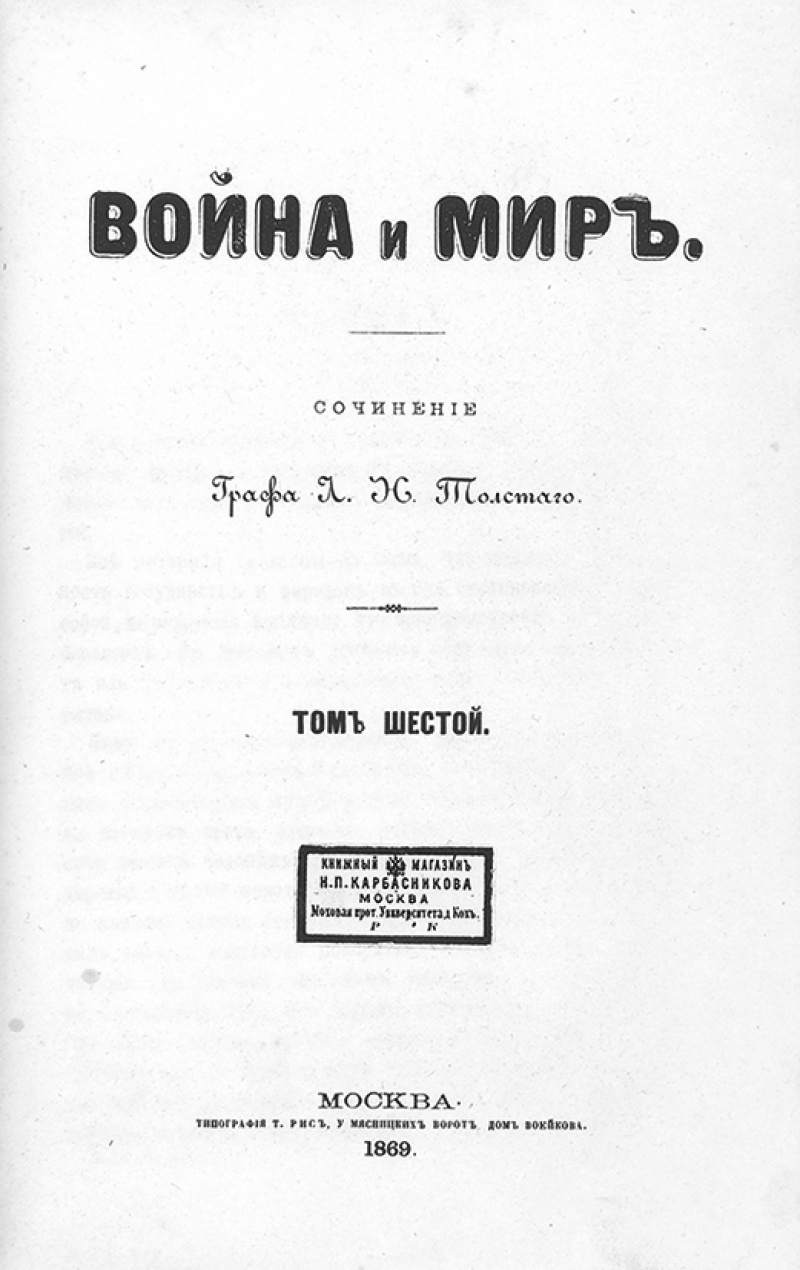
War and Peace by Leo Tolstoy
Theodoros Kafantaris
Published on July 07, 2026
1. Introduction
There are novels, and then there is War and Peace. Leo Tolstoy's monumental work (1869) is not merely a book—it is a universe. Spanning over 1,200 pages, it interweaves the lives of five aristocratic Russian families against the cataclysm of Napoleon's 1812 invasion. Tolstoy himself refused to call it a novel, preferring "not a novel, still less a poem, and still less a historical chronicle." Whatever it is, it remains one of the supreme achievements of human art—a work that attempts nothing less than to capture the totality of human experience: love, war, birth, death, ambition, failure, faith, and doubt.
What makes War and Peace truly revolutionary is its philosophy of history. Tolstoy argues that great men do not make history—Napoleon is not a genius but a puppet of millions of微小 causes, swept along by forces he neither controls nor understands. History, Tolstoy insists, is determined by the sum of countless individual wills, not by kings or generals. This radical philosophy transforms the novel into something far more ambitious than historical fiction: an attempt to understand the nature of causation itself.
2. About the Author
Author: Leo Tolstoy (1828–1910)
Count Lev Nikolayevich Tolstoy was born into Russian aristocracy and spent his youth in dissipation—gambling, drinking, and womanizing—before a spiritual crisis in middle age transformed him into a radical Christian anarchist who renounced his wealth, advocated celibacy, and influenced both Gandhi and Martin Luther King Jr. He fought in the Crimean War, fathered thirteen children, and was excommunicated by the Russian Orthodox Church. He died in 1910 at a remote railway station, having fled his home at 82 in a final, desperate search for spiritual authenticity. His grave—a simple mound of earth in a forest—bears no cross, no name, no inscription. It is, like his greatest novel, an argument for simplicity as the highest form of wisdom.
3. Story Overview
War and Peace is set in Russia between 1805 and 1820, centering on five aristocratic families: the Bezukhovs, Bolkonskys, Rostovs, Kuragins, and Drubetskoys. The narrative alternates between scenes of domestic life and epic battle sequences, following key characters through love, loss, and spiritual transformation. The novel opens with a soirée at Anna Pavlovna Scherer's, introducing Pierre Bezukhov, the illegitimate son of a wealthy count; Prince Andrei Bolkonsky, a disillusioned nobleman seeking glory; and Natasha Rostova, a vivacious young girl full of life. These three characters form the emotional and philosophical core of the story.
The plot unfolds across several major arcs. Pierre inherits his father's fortune and marries the beautiful but shallow Hélène Kuragina, a union that brings him misery. He joins the Freemasons in search of meaning, attempts to reform his estates, and eventually becomes obsessed with the idea of assassinating Napoleon. After the Battle of Borodino, he stays in Moscow as the French occupy the city, witnesses the burning of Moscow, and is taken prisoner. During his captivity, he meets Platon Karataev, a peasant soldier whose simple faith and acceptance of life transform Pierre's worldview. He emerges with a newfound peace, finding meaning in ordinary human connections.
Prince Andrei, meanwhile, serves as an aide-de-camp to General Kutuzov and dreams of glory. At the Battle of Austerlitz, he is wounded and left for dead, gazing up at the infinite sky—a moment that shatters his illusions. He returns home to find his wife dying in childbirth, and sinks into cynicism. Natasha Rostova reawakens his capacity for love, but their engagement is broken when Natasha nearly elopes with the scoundrel Anatole Kuragin. Andrei rejoins the army and is mortally wounded at Borodino. In his final days, he experiences a spiritual awakening, forgiving his enemies and embracing a love that transcends earthly attachments. His death is one of the most profound passages in literature.
Natasha's journey is equally transformative. She begins as a spontaneous, charming girl, full of energy and emotion. Her near-disaster with Anatole leads to public shame and deep remorse. She nurses the wounded Andrei during his final days, and after the war, she marries Pierre, becoming a devoted wife and mother. Tolstoy portrays her as the embodiment of life itself—intuitive, emotional, and ultimately grounded in domestic happiness. The novel also follows Nikolai Rostov, Natasha's brother, who matures through his military service and marries Princess Marya Bolkonskaya, Andrei's sister, uniting the families.
The war sections are integral to the novel's philosophy. Tolstoy depicts battles not as heroic clashes but as chaotic, senseless events where individual actions have little impact. General Kutuzov, the Russian commander, is portrayed as a wise old man who understands that patience and time are the true weapons. Napoleon, by contrast, is shown as a vain, self-absorbed leader whose orders are irrelevant. The novel's famous epilogue discusses the philosophy of history, arguing that historical events are the result of countless infinitesimal causes, not the will of great men. Through its vast scope and intimate detail, War and Peace explores themes of fate, free will, love, death, and the search for meaning—all while telling a deeply human story.
4. Key Takeaways
- Great men are illusions. Napoleon appears not as a genius but as a fat, self-satisfied mediocrity whose orders make no difference on the battlefield. History is shaped by the collective actions of ordinary people, not by the will of so-called heroes.
- Life is found in the ordinary. Pierre discovers meaning not in grand ideas but in simple human connection—sharing food, sitting by a fire, holding a child. True happiness comes from embracing the everyday.
- The heart has reasons reason cannot know. Tolstoy, the rationalist who became a mystic, ultimately values intuition over intellect. Characters like Natasha and Platon Karataev embody a wisdom that transcends logic.
- Freedom is submission to the flow of life. Kutuzov's genius is knowing when to do nothing—a wisdom Pierre and Andrei learn only through suffering. Accepting what cannot be controlled brings inner peace.
- Every life contains an epic. The novel insists that the quietest, most ordinary existence is as significant as any battlefield. The domestic lives of the Rostovs and Bolkonskys are portrayed with as much depth as the war scenes.
5. Why This Book Is a Must Read
War and Peace earns its place among the "100 Books You Must Read" because it is not simply a novel but an education in how to live. To read it is to spend months in the company of characters who become more real than most people we know. From a literary perspective, it redefined what fiction could encompass—history, philosophy, domestic drama, and spiritual autobiography woven into a single seamless vision. From a personal growth perspective, it offers a philosophy of life that is simultaneously demanding and forgiving: strive, but know that striving is not the same as controlling; love, but know that love requires surrender; seek meaning, but find it in the ordinary rather than the extraordinary. Few books reward the investment of time so completely.


