
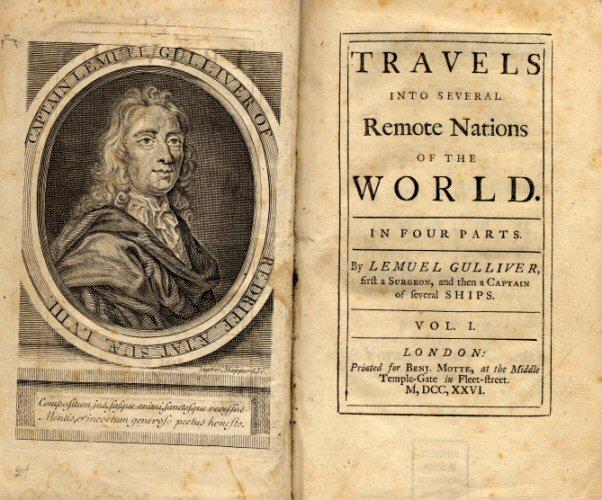
Gulliver's Travels by Jonathan Swift
Theodoros Kafantaris
Published on July 07, 2026
1. Introduction
If you think modern satire is sharp, wait until you meet the 18th-century original. Jonathan Swift's Gulliver's Travels (1726) appears at first glance to be a children's adventure about a ship's surgeon who visits strange lands of tiny people, giants, and talking horses. In reality, it is one of the most devastating satires ever written—an unsparing indictment of politics, science, religion, and the very nature of humanity. Swift wrote it, he said, "to vex the world rather than divert it." He succeeded on both counts, and nearly 300 years later, the vexation continues.
Considered the greatest satire in the English language, Gulliver's Travels has influenced everyone from George Orwell to Terry Pratchett. It remains essential because its targets—political corruption, scientific hubris, religious conflict, human vanity—are, depressingly, still with us. Swift's dark vision suggests that humanity's flaws are not historical accidents but permanent features of our nature.
2. About the Author
Jonathan Swift (1667–1745) was an Anglo-Irish clergyman who became the most feared satirist of his age. Dean of St. Patrick's Cathedral in Dublin, he wrote pamphlets so incendiary that the British government offered rewards for identifying their author. His A Modest Proposal—suggesting the Irish sell their children as food to the rich—remains the most famous satirical essay in English. Swift was a man of profound contradictions: a misanthrope who loved individuals, a churchman who savaged religious hypocrisy, a defender of Irish rights who wished he had been born in England. He died in 1745, having left his fortune to found a hospital for the mentally ill—a final joke at humanity's expense that also revealed his genuine compassion.
3. Story Overview
Lemuel Gulliver, an English surgeon and sea captain, narrates four extraordinary voyages that take him to lands where the inhabitants challenge his—and our—assumptions about humanity. The book is structured as a travel memoir, but each destination serves as a satirical mirror held up to European society. Swift uses Gulliver's shifting perspectives—from giant to dwarf, from observer to specimen—to expose the absurdity of human pride and the fragility of our claims to civilization.
In the first voyage, Gulliver is shipwrecked on Lilliput, an island of six-inch-tall people. He becomes a giant among them, but his size does not grant him wisdom. The Lilliputians are consumed by petty political disputes: they wage war over which end of an egg to crack (a satire of religious conflicts between Catholics and Protestants), and courtiers gain favor by jumping over a stick. Gulliver's initial admiration for their sophistication gives way to horror as he realizes that their smallness is not just physical but moral. This section skewers the triviality of political ambition and the absurdity of conflicts based on dogma.
The second voyage reverses the scale: in Brobdingnag, Gulliver is a tiny curiosity among giants. The King of Brobdingnag, after hearing Gulliver's proud account of European gunpowder, law, and politics, declares the English to be "the most pernicious race of little odious vermin that nature ever suffered to crawl upon the surface of the earth." This reversal forces readers to see their own world through alien eyes, revealing the violence and hypocrisy that Gulliver (and by extension, Swift's contemporaries) takes for granted. The Brobdingnagians, though physically large, are morally superior—a pointed contrast to the Lilliputians' pettiness.
The third voyage is the most episodic, taking Gulliver to the flying island of Laputa, where scientists are so absorbed in abstract thought they need servants to hit them with bladders to pay attention. Their experiments—extracting sunbeams from cucumbers, building houses from the roof down—mock the excesses of Enlightenment rationalism. Swift also visits the island of Glubbdubdrib, where Gulliver summons historical figures and finds that recorded history is a pack of lies. This section critiques the arrogance of pure reason divorced from human experience and the corruption of knowledge by power.
The final voyage is the darkest and most disturbing. Gulliver lands in the land of the Houyhnhnms, rational horses who live in harmony, governed by reason and benevolence. They are contrasted with the Yahoos, filthy, brutish human-like creatures who embody every vice Swift despised: greed, lust, violence, and irrationality. Gulliver comes to idealize the Houyhnhnms and loathe the Yahoos—including himself. When he is forced to leave, he returns to England unable to bear the sight or smell of his own family, preferring the company of horses in his stable. The ending is a devastating indictment of misanthropy: Swift shows that hating humanity, taken to its logical extreme, becomes a form of madness. The novel thus forces readers to confront the uncomfortable possibility that our flaws are not accidental but essential to our nature.
4. Key Takeaways
- Satire outlasts its targets: Swift's critique of power, science, and pride transcends his era because the flaws he mocked are permanent.
- Perspective is everything: Each voyage forces us to see humanity from a new angle—and the view is rarely flattering.
- Reason without compassion is monstrous: The rational Houyhnhnms are incapable of love, suggesting pure logic is as dangerous as pure emotion.
- Progress is not inevitable: Swift wrote during the Enlightenment but saw no reason to believe reason would make us better.
- Laughter is the sharpest weapon: Swift understood that people will tolerate being told they are wrong more readily than being mocked—and mockery is harder to forget.
5. Why This Book Is a Must Read
Gulliver's Travels earns its place among the "100 Books You Must Read" because it is the fountainhead of satirical literature in English, a work of such savage wit that it remains both hilarious and horrifying nearly three centuries later. From a literary perspective, it established the template for every satirical travelogue that followed—from Candide to Brave New World. From a philosophical perspective, it poses uncomfortable questions about human nature that we have still not answered. And from a personal growth perspective, it teaches us that the ability to laugh at ourselves—truly laugh, not defensively—may be the most difficult and most necessary form of wisdom.


